
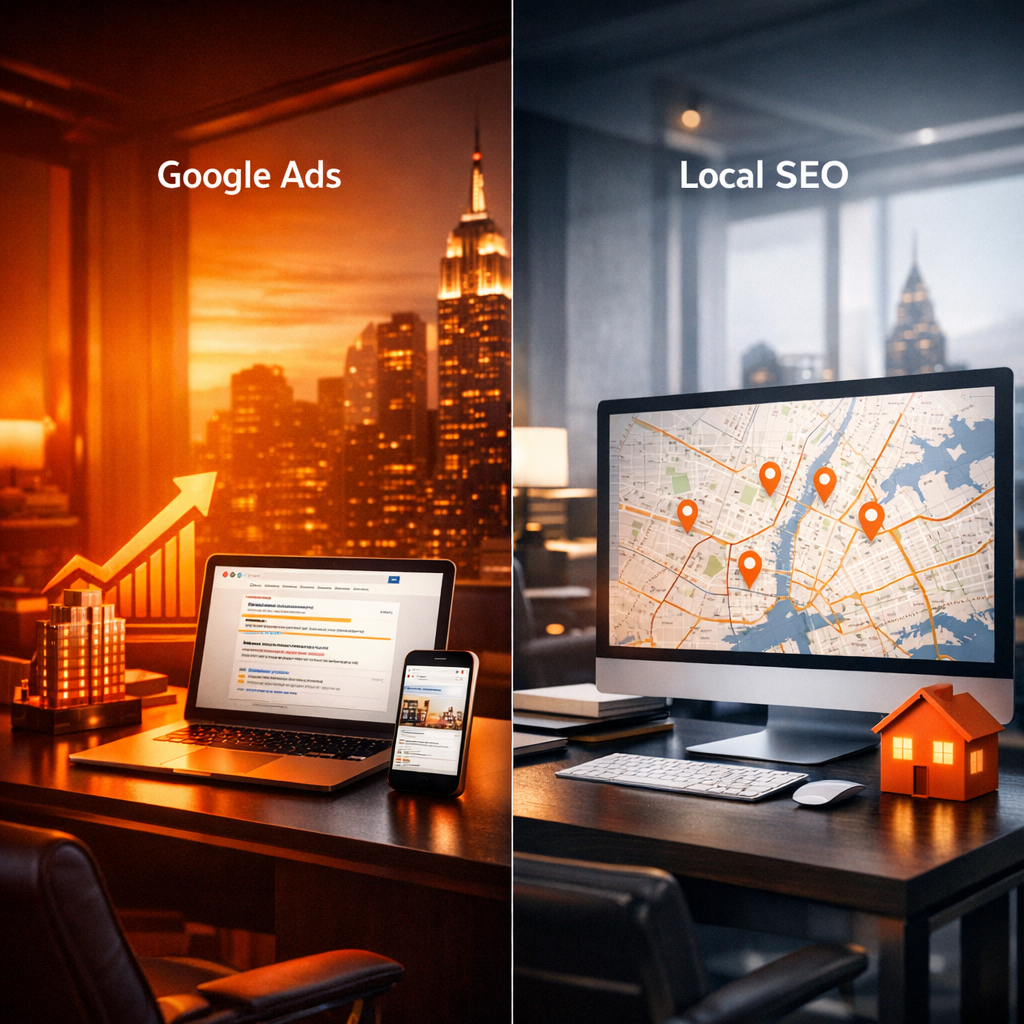
Google Ads vs Local SEO for New York Real Estate: What Wins in 2026?
New York real estate is expensive, fast, and competitive. So, every lead channel must prove value quickly. That is why many brokers ask the same question: should they invest in Google Ads or local SEO?
The short answer is this: it depends on your pipeline, budget, and timeline. However, in 2026, the smartest firms will not choose one forever. They will use each channel for a different growth purpose.
Why This Decision Matters More in New York
Search behavior in New York is intense. Buyers and sellers often search with high intent, but they also compare many options. As a result, visibility at the right moment can decide who gets the call.
If you need immediate traffic, Google Ads can help. If you want long-term authority and lower acquisition costs, local SEO can build that advantage. Therefore, the real question is which one fits your current business goal.
Google Ads: Fast Results, Clear Intent
Google Ads gives real estate businesses instant placement on search results. That matters when you launch a new listing, open a new office, or need leads this week. In addition, you can target neighborhoods, zip codes, and high-intent keywords.
This channel works well for luxury listings, seller leads, commercial property searches, and urgent campaigns. It also gives you measurable data fast. You can see clicks, calls, and conversions within days.
Best Use Cases for Google Ads
- New York property launches that need immediate visibility
- Brokerage lead generation with short sales cycles
- High-value listing promotion in competitive boroughs
- Seasonal campaigns and open house traffic
Still, Google Ads has a clear downside. Costs can rise quickly in New York markets. Moreover, performance stops when your budget stops. So, you rent attention rather than own it.
If you need expert execution, a focused Google Ads strategy for real estate can improve targeting, reduce waste, and increase qualified lead volume.
Local SEO: Durable Visibility and Lower Long-Term Costs
Local SEO helps your business appear in map results, local packs, and organic rankings. For New York real estate, that means visibility for searches like “best real estate agent in Brooklyn” or “Manhattan condo expert.” These searches often show strong buying intent.
Unlike paid ads, local SEO compounds over time. That means every optimized page, review, citation, and neighborhood landing page can keep working for months. In turn, you reduce dependence on paid media.
Best Use Cases for Local SEO
- Agents building authority in specific boroughs or neighborhoods
- Brokerages that want steady inbound leads
- Teams targeting long-tail queries with local intent
- Brands aiming to dominate Google Maps visibility
Local SEO takes longer to deliver results. However, it usually creates lower cost per lead over time. It also supports trust. In real estate, trust often drives the final contact form submission.
For firms that want scalable location visibility, local SEO services for New York businesses can strengthen map rankings, local authority, and neighborhood-level demand capture.
Google Ads vs Local SEO for New York Real Estate: Side-by-Side
Google Ads wins on speed. Local SEO wins on sustainability. Therefore, your budget should reflect your objective.
Speed, Cost, and ROI Comparison
- Speed: Google Ads is immediate. Local SEO takes time.
- Cost: Ads require ongoing spend. SEO requires upfront investment and maintenance.
- Intent: Both capture intent, but SEO often wins higher trust.
- Scalability: Ads scale fast. SEO scales efficiently over time.
- Longevity: Ads disappear when spend ends. SEO assets can keep ranking.
In New York, this tradeoff is even sharper. Competition pushes Google Ads costs higher. At the same time, local rankings can unlock repeat visibility without paying for every click.
What 2026 Data Trends Suggest
In 2026, real estate marketers will face more expensive clicks, more AI-influenced search results, and stronger local intent signals. Because of that, businesses that rely only on ads may feel margin pressure.
Meanwhile, local SEO will matter more for map visibility, branded search defense, and hyper-local discovery. Searchers want nearby expertise, verified trust, and useful content. So, firms that build local authority will likely outperform those that chase traffic alone.
That said, Google Ads still plays a vital role. It remains the fastest way to test offers, validate messaging, and drive listings in competitive periods. Therefore, the best data-driven strategy uses both channels in sequence.
The Best Strategy: Combine Both Channels
Start with Google Ads when you need immediate lead flow. Use it to test which neighborhoods, services, and offers convert best. Then, use those insights to shape your SEO and content strategy.
Next, build local SEO around the winning themes. Create neighborhood pages, service pages, review assets, and market-specific content. Over time, this reduces paid dependency and improves total ROI.
A Smarter Allocation Model
- Use Google Ads for short-term demand capture
- Use local SEO for long-term market ownership
- Use content marketing to support both channels
- Use landing pages to improve conversion rates
If your website is weak, both channels underperform. That is why strong site structure matters. A conversion-focused real estate web development solution can improve speed, mobile usability, and lead capture across all campaigns.
Final Verdict: Which One Should You Choose?
If you need leads now, choose Google Ads. If you want lasting visibility and lower acquisition costs, choose local SEO. If you want the best 2026 outcome in New York real estate, use both strategically.
In practice, the winning formula is simple. Ads create momentum. SEO creates equity. Together, they help brokers and agents build a stronger pipeline in one of the most competitive markets in the world.
If you want a more efficient growth plan, DigiPrime can help you align search, web, and lead generation into one measurable system.